
|
Getting your Trinity Audio player ready...
|
Chinese EV innovation is moving at lightning speed—and the global auto industry is scrambling to keep up. Brands like BYD, XPeng, and NIO are launching feature-rich electric cars faster and cheaper than legacy automakers can redesign dashboards. While Volkswagen, Toyota, and GM fine-tune their EV strategy, Chinese brands are already capturing market share in Europe, Southeast Asia, and even Latin America.
This is no longer a battle between East and West—it’s a test of who can deliver the EVs that people want, at a price they can afford, without waiting five years for it. The question is: can legacy giants adapt quickly enough to survive?
What’s Driving Chinese EV Innovation?
When we talk about Chinese EV innovation, we’re talking about speed, scale, and smart integration. Chinese automakers aren’t just building electric vehicles—they’re redefining how fast a car can go from concept to road. Brands like BYD and XPeng are leading this charge thanks to a few critical advantages.
First, vertical integration is key. BYD, for example, produces its own batteries, semiconductors, and even electric motors. This tight control over the supply chain allows them to cut costs and launch updates faster than legacy automakers stuck relying on dozens of suppliers. Meanwhile, CATL, China’s battery powerhouse, continues to lead in both performance and affordability—fueling not only domestic brands but also global EV players.
Second, China’s government support and EV-first infrastructure have created a perfect breeding ground for rapid development. Tax breaks, free license plates in major cities, and nationwide charging networks have pushed adoption far beyond what most Western countries have achieved. These policies allow Chinese brands to experiment aggressively with features like swappable batteries, voice-first infotainment, and smart ADAS systems—features that feel futuristic compared to what many legacy automakers offer.
Finally, Chinese EV makers operate with startup agility. Their development cycles are measured in months, not years. They listen to user feedback in real time and push over-the-air updates frequently. While traditional automakers still ship vehicles with software that’s outdated on delivery, companies like NIO are deploying monthly OTA upgrades that change everything from suspension tuning to UI layout.
Put simply, Chinese EV innovation isn’t just catching up—it’s leading the curve in how electric cars should perform, feel, and be priced.
Where Legacy Automakers Are Falling Behind
Legacy automakers are struggling to match the speed and affordability of their Chinese competitors. Companies like Volkswagen, Ford, and General Motors are heavily burdened by outdated production platforms, complex supplier networks, and internal resistance to change. In many cases, they’re trying to retrofit electric drivetrains into chassis originally designed for combustion engines—resulting in heavier, less efficient EVs that cost more and deliver less. Worse still, software continues to be a pain point. VW’s troubled Cariad division, for instance, has delayed multiple models due to glitchy infotainment and slow UI systems, a problem that fast-moving Chinese brands have already solved.
Another major hurdle is price competitiveness. While Chinese brands are delivering well-equipped EVs for under $30,000, legacy brands are struggling to get there without heavy subsidies or sacrificing key features. They’re also caught in a dilemma: move too fast, and they risk cannibalizing their profitable combustion vehicle sales; move too slow, and they risk irrelevance in the fastest-growing segment of the auto market. The result? A lot of hesitation and half-measures while Chinese EV makers continue to gain ground.
The Global Market Reaction
Markets around the world are taking notice of Chinese EV innovation—and not always in a welcoming way. In Europe, Chinese brands like MG (owned by SAIC), BYD, and NIO have rapidly expanded their presence, offering affordable EVs packed with tech. This has prompted the European Union to launch tariff investigations over concerns of unfair pricing and government subsidies. But tariffs or not, customers are responding to the value: reliable range, smart interiors, and prices that undercut the competition by thousands of euros.
In the United States, direct Chinese imports are limited, but the pressure is being felt. Tesla has lowered prices repeatedly to stay ahead, and legacy players like Ford and GM have struggled to maintain margins while attempting to meet demand. Meanwhile, South America, Southeast Asia, and the Middle East are emerging as key battlegrounds, where affordability trumps brand legacy—and Chinese EVs are flooding in. The global EV landscape is shifting, and Chinese innovation is clearly one of the major forces behind that transformation.
Who Has the Edge in the Long Run?
Chinese EV innovation may lead today’s race in terms of speed and affordability, but legacy automakers aren’t out of the game yet. Brands like Toyota, BMW, and Mercedes-Benz still command massive global trust, scale, and after-sales support—factors that matter to mainstream buyers. Their long-standing presence in key markets gives them a foundation Chinese newcomers still lack. Plus, when legacy players finally get their EV platforms right, they have the power to scale quickly across regions where regulation, loyalty, and infrastructure align.
However, Chinese brands have momentum, and their relentless innovation cycle doesn’t appear to be slowing down. They are mastering every layer—from batteries to software—and proving they can deliver EVs that resonate globally. If they manage to overcome concerns about data privacy, brand perception, and servicing infrastructure, they may permanently shift the EV hierarchy.
Ultimately, the edge will go to the companies that combine fast innovation with reliability, affordability, and support. Whether that’s a reshaped legacy giant or a fast-rising Chinese disruptor depends on who adapts fastest in the next three years.
Verdict & Outlook
The battle between legacy automakers and Chinese EV innovators is more than a corporate showdown—it’s a defining moment for the future of global mobility. Chinese brands are proving that electric cars don’t have to be expensive or boring, while traditional players are learning—often the hard way—that heritage alone won’t win the EV era.
As the gap between innovation speed and brand trust narrows, we expect to see more collaborations, joint ventures, and even market exits. Some legacy brands will adapt and thrive, others may fade. Meanwhile, Chinese EV makers will either solidify their position or face resistance as governments tighten policies and tariffs to protect domestic industries.
The coming years will tell whether this is a disruption or a realignment. But one thing is certain: Chinese EV innovationhas already changed the game—and there’s no turning back.
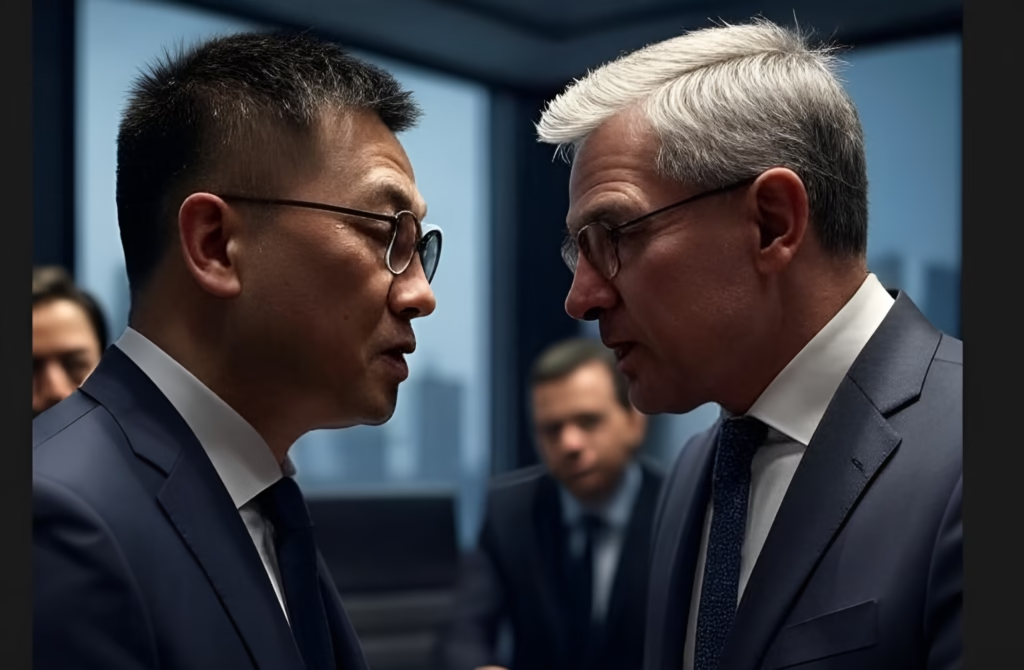
Disclaimer The image used in this article is AI-generated and does not represent any specific person, vehicle or brand. It is intended for illustrative purposes only.