
|
Getting your Trinity Audio player ready...
|
The Citroën Ami is a unique take on urban mobility, designed as an ultra-compact, affordable electric vehicle aimed at short city commutes. Developed under Stellantis, the automotive giant behind brands like Peugeot, Fiat, and Opel, the Ami is manufactured in Morocco and has gained traction both locally and in European markets. Originally introduced as a response to increasing urban congestion and rising fuel prices, this tiny EV provides an alternative to traditional cars and public transportation, targeting young drivers, delivery services, and city dwellers who need a practical and cost-effective way to get around.
What makes the Citroën Ami stand out is its simplicity and affordability. Since this is a quadricycle in Europe, you can drive it even if you are a teenager in some countries. In Morocco, the Ami has found an unexpected niche as a delivery and postal service vehicle, commonly used by mailmen and local businesses for quick trips within cities. Its small footprint allows easy parking, a major advantage in crowded urban areas like Casablanca and Rabat, where parking is often a nightmare.
However, while the Ami is practical for city mobility, it also raises questions about safety, comfort, and long-term viability. Unlike conventional cars, it lacks airbags, high-speed capabilities, and a robust structure, which may concern some buyers. Additionally, while it is a great fit for short, low-speed trips, it might not be suitable for highways or longer commutes. As Morocco continues to explore sustainable transport solutions, the Citroën Ami offers an interesting option but is it truly the answer to city mobility challenges, or just a temporary trend?
Exterior design
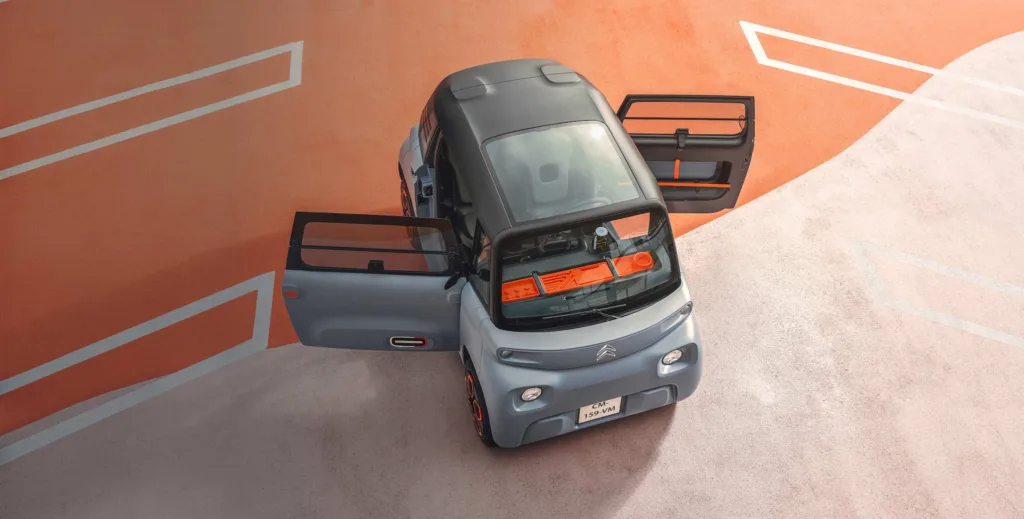
The Citroën Ami has one of the most unconventional exterior designs in the automotive world, crafted with cost efficiency and simplicity at its core. With its boxy, compact shape, this ultra-mini electric vehicle measures just 2.41 meters in length, making it shorter than many motorcycles and allowing it to be parked in the tightest urban spots. The design prioritizes functionality over aesthetics, giving the Ami a symmetrical, almost toy-like appearance that sets it apart from any other vehicle on the road.
One of the most fascinating cost-cutting aspects of the Ami is the way Citroën has minimized unique parts in its construction. The front and rear bumpers are identical, meaning they can be interchanged, reducing production complexity and costs. Similarly, the left and right doors are the same, but they open in opposite directions—the driver’s side door is rear-hinged (suicide door), while the passenger’s side opens normally. This quirky feature not only saves manufacturing costs but also enhances ease of access in tight spaces.
The Ami’s exterior panels are all made of lightweight plastic, further cutting down costs and making the car easy to maintain. Instead of glossy paint, the vehicle features pre-colored molded plastic, which means there’s no need for expensive paint jobs—a clever way to reduce both production and repair costs. Large windows provide a panoramic view, while the glass roof, which comes as standard, adds a touch of openness to the otherwise minimalist design. The headlights and taillights are simple, circular LED units, contributing to its quirky, futuristic look.
Despite its basic, cost-cutting approach, the Citroën Ami’s exterior is practical and innovative, proving that affordable city mobility doesn’t have to follow traditional car-making rules. Every aspect of its design focuses on ease of production, low maintenance, and maximum functionality, making it a truly one-of-a-kind urban transport solution.
Interior, build quality and quirks
The Citroën Ami’s interior is as barebones as it gets, designed with cost-cutting and practicality in mind rather than luxury or comfort. The cabin is small and utilitarian, fitting just two seats side by side, making it ideal for short city trips but far from spacious. Every surface inside is hard, brittle plastic, giving it a basic, industrial feel rather than a premium one. There are no soft-touch materials, no fancy trim, and certainly no advanced technology—just the absolute essentials to keep costs down.
With an extremely limited storage. Unlike most cars, the Ami doesn’t have a trunk or even a front storage compartment (frunk). Instead, a small open space in front of the passenger seat serves as the main storage area, large enough for a backpack or a few grocery bags. There are also a few molded plastic compartments to hold small items like a phone or water bottle, but nothing more.
The dashboard is ultra-minimalist, featuring a tiny digital display behind the steering wheel that shows only the essential driving information, such as speed and battery charge. There’s no traditional infotainment system, but Citroën has provided a simple smartphone holder, expecting drivers to use their phones for navigation and music. A single heater fan is the only climate control option, meaning there’s no air conditioning, making summer drives in hot regions uncomfortable.
One quirky but practical touch is the glass roof, which brings in natural light and helps make the tiny cabin feel a little more airy. However, rocking some fixed windows that you can pop open slightly, ventilation is quite limited. Overall, the Citroën Ami’s interior is extremely basic, functional, and cost-effective, designed purely for city mobility without any unnecessary extras.
Performance and Range of the Citroën Ami
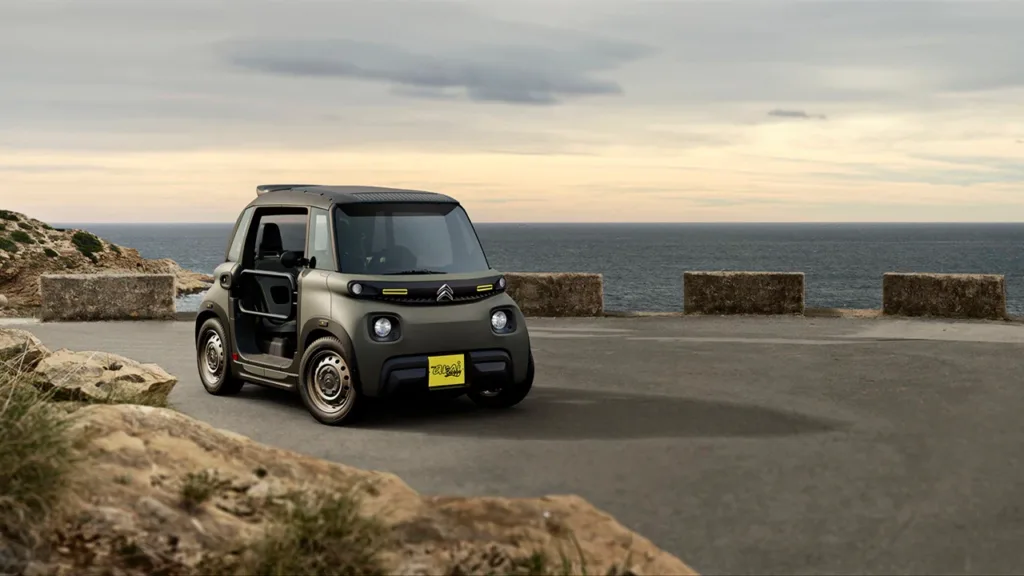
The Citroën Ami is a city-focused mobility solution, so performance is not its strong suit. Under the small, boxy body, we find a 6 kW (8 horsepower) electric motor, which is far below even the weakest conventional cars. This means acceleration is slow and gradual, but considering what the Ami means for urban environments, this isn’t necessarily a dealbreaker. A top speed limited to just 45 km/h (28 mph), making it unsuitable for highways or fast-moving roads but ideal for navigating narrow city streets and dense traffic.
When it comes to range, the Citroën Ami comes with a 5.5 kWh lithium-ion battery, which gives a maximum range of around 75 km (46 miles) on a full charge. This is more than enough for daily city commutes, as most urban trips rarely exceed this distance. Charging is also simple and convenient, you can plug the Ami into a standard household socket, taking around 3 hours for a full charge. Unlike larger EVs, there’s no fast-charging option, but considering the small battery size, the standard charging time remains reasonable.
Conclusion: A High Price for Moroccan Roads
Despite its clever cost-cutting design, the Citroën Ami comes with a surprisingly high price tag in Morocco. While in Europe, Ami is affordable urban mobility solution, its Moroccan price of 107,000 MAD makes it significantly more expensive than expected for what it offers. Given that the Ami is essentially a bare-bones electric quadricycle, with no frills, minimal comfort, and extremely basic materials, many buyers will find it hard to justify the price.
For comparison, Chinese micro-EVs in the same category, such as the Wuling Mini EV, often offer more features, better range, and slightly higher speeds at a lower price point. This makes the Ami look like a luxury product in Morocco, rather than an accessible urban solution. While it may find a niche market among companies like mail services or delivery fleets, for the average Moroccan commuter, the high cost and limited practicality could make other options—like electric scooters or small city cars—a more logical choice.
