
|
Getting your Trinity Audio player ready...
|
Tesla stock plunge July 2025 is making headlines, as the electric vehicle giant faces one of its toughest weeks in recent memory. In the span of just a few days, Tesla’s share price dropped over 6.5%, following a surprising political announcement by CEO Elon Musk and disappointing global delivery numbers for Q2.
Investors are now asking: Is Tesla losing focus? With Musk announcing the formation of his own political movement—dubbed the America Party—and Tesla’s long-touted robotaxi plan inching toward reality, questions are swirling about whether the company can keep its momentum in the EV race while chasing multiple fronts.
Market Reaction: A Sharp Drop in Tesla’s Value
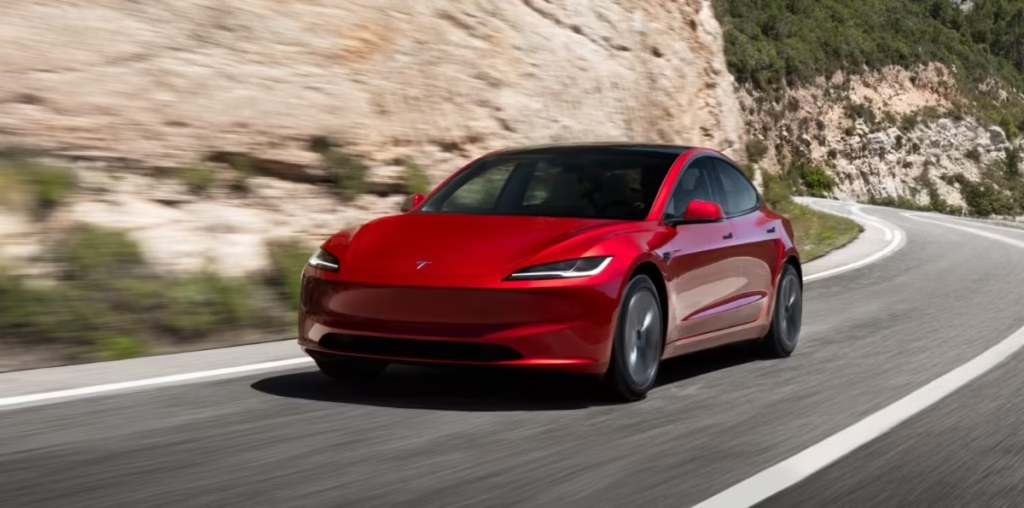
The week kicked off with a dramatic blow to investor confidence. Tesla’s stock fell by 6.6%, wiping billions from its market cap in just one trading session. The drop came hours after Elon Musk publicly confirmed the creation of the “America Party,” a political initiative he plans to lead heading into the 2026 U.S. elections.
While Musk’s ventures into politics are nothing new, this direct involvement sparked immediate concern on Wall Street. Investors worry that Tesla’s CEO is once again splitting his attention—already stretched thin across Tesla, SpaceX, xAI, and other ventures.
To make matters worse, the expiration of the U.S. federal $7,500 EV tax credit for Tesla buyers added more fuel to the fire. With pricing advantages fading, analysts predict a tougher road ahead for Tesla’s core product lineup—especially in a cooling EV market.
Musk’s “America Party” and Political Distraction

Elon Musk’s announcement of the “America Party”—a new political movement he intends to champion—sent shockwaves beyond the political arena and deep into Tesla’s investor base. The move, while aligned with Musk’s long history of vocal involvement in public discourse, has introduced a new layer of uncertainty for shareholders.
From a strategic perspective, Musk’s influence and visibility could position him as a powerful political force, potentially shaping future U.S. policy around energy, automation, and industry. Supporters argue that having a CEO so involved in national affairs might eventually benefit Tesla through pro-innovation, pro-manufacturing legislation.
However, in the short term, this is undeniably a gamble. Musk is the public face of Tesla, and when his focus shifts, the company feels the impact. Critics and investors alike have voiced concerns that dividing attention across politics, AI ventures, and ongoing Tesla operations may slow product innovation and affect strategic decisions.
While only time will tell whether this bold move pays off for Musk and Tesla, the immediate market reaction suggests unease, with some wondering if the brand can retain its edge while its CEO balances multiple high-stakes roles.
Global Sales Under Pressure
Tesla’s global momentum is showing signs of fatigue. In Q2 2025, the company reported a 13.5% drop in deliveries year-over-year, marking one of its steepest declines in recent memory. While global EV demand is still growing, Tesla appears to be losing market share, especially in regions where competitors have become more aggressive.
China, once Tesla’s fastest-growing and most profitable market, has turned into a fierce battleground. Domestic players like BYD, Xiaomi, and Zeekr are rapidly innovating, offering well-equipped electric cars at lower prices. Their vehicles now match or even exceed Tesla in terms of range, features, and design. As a result, Tesla’s lead in China is shrinking, with the Model 3 and Model Y facing intense pricing pressure.
At the same time, sales in Europe and the U.S. have softened, partially due to EV incentive rollbacks and growing buyer fatigue in a saturated premium segment. Without major refreshes or new entry-level models to inject excitement, Tesla’s product lineup is starting to feel dated next to flashier and more affordable alternatives.
For a company that once dominated the EV conversation, this slowdown is a reminder that the competitive landscape has evolved—and Tesla now plays in a field it helped create, but no longer controls.
Tesla’s Robotaxi Bet: Distraction or Disruption?
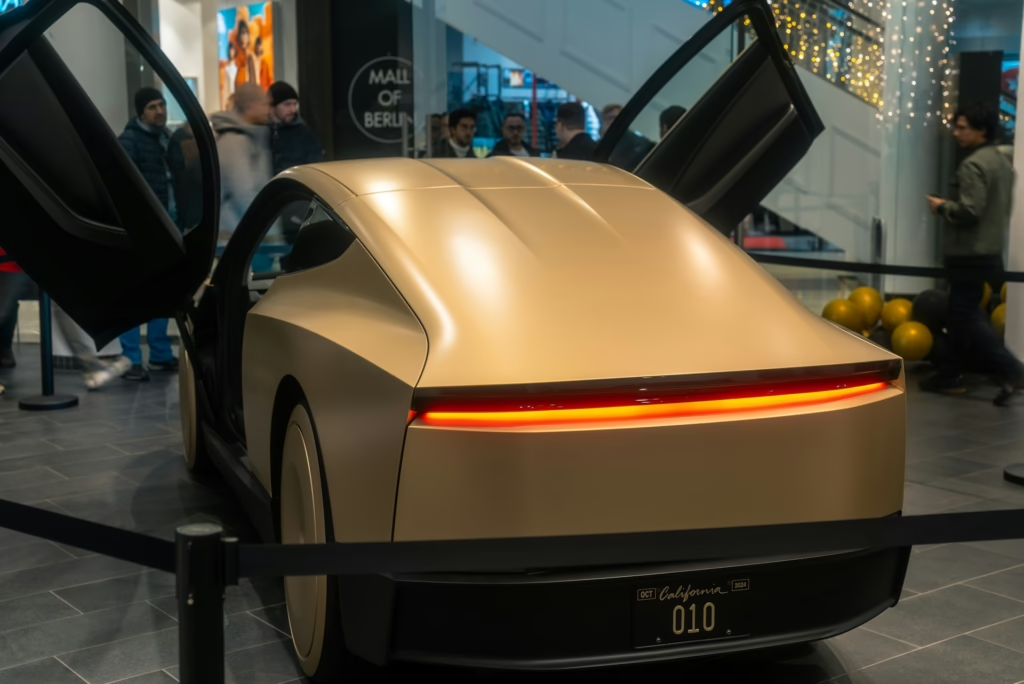
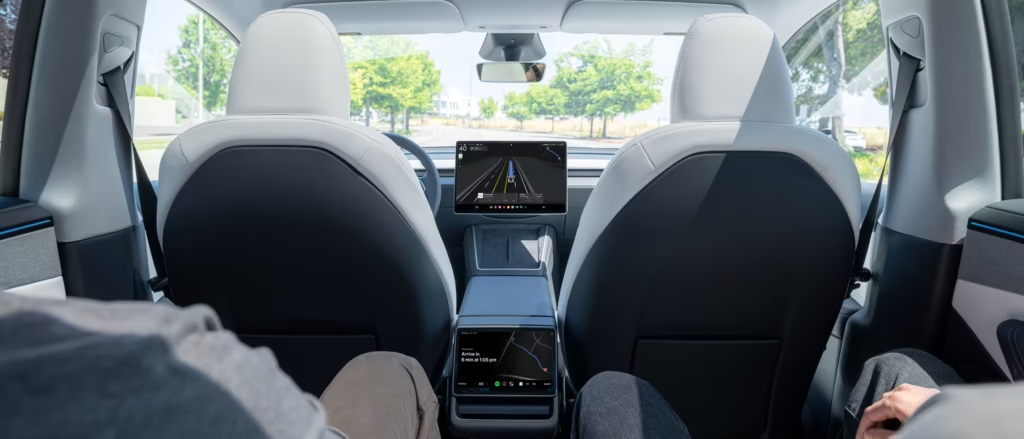
Amid sales pressure and a shifting competitive landscape, Tesla is doubling down on its long-promised robotaxi vision. CEO Elon Musk recently teased the debut of Tesla’s “Cybercab”, a fully autonomous ride-hailing vehicle expected to be unveiled later this year. The company is betting big on autonomy—calling it the future of transportation, and perhaps Tesla’s next major revenue stream.
But this ambitious move is met with growing skepticism. Tesla has been promising full self-driving capabilities for nearly a decade, yet its FSD (Full Self-Driving) software remains in beta testing with no regulatory approval for unsupervised operation.
In contrast, companies like Waymo and Cruise have already launched limited driverless taxi services in U.S. cities, with clearly defined geofenced zones and strict safety protocols.
While the vision of a fully autonomous Tesla robotaxi fleet remains compelling, its feasibility and timeline are unclear, and some investors worry that the company is diverting energy and resources toward a future that may still be years away.Tesla’s Robotaxi Bet: Distraction or Disruption?
Amid sales pressure and a shifting competitive landscape, Tesla is doubling down on its long-promised robotaxi vision. CEO Elon Musk recently teased the debut of Tesla’s “Cybercab”, a fully autonomous ride-hailing vehicle expected to be unveiled later this year. The company is betting big on autonomy—calling it the future of transportation, and perhaps Tesla’s next major revenue stream.
But this ambitious move is facing growing skepticism. Tesla has been promising full self-driving capabilities for nearly a decade, yet its FSD (Full Self-Driving) software remains in beta testing with no regulatory approval for unsupervised operation. In contrast, companies like Waymo and Cruise have already launched limited driverless taxi services in U.S. cities, with clearly defined geofenced zones and strict safety protocols.
Waymo’s vehicles, for example, operate entirely without human drivers in parts of Phoenix and San Francisco. Meanwhile, Cruise and other players are expanding cautiously but steadily. Tesla’s approach, on the other hand, is software-first and relies entirely on cameras and neural networks.
Conclusion – A Defining Moment for Tesla
Tesla stands at a critical crossroads. With its stock under pressure, global sales slowing, and new distractions—political and technological—entering the picture, investors and EV enthusiasts alike are watching closely. Elon Musk’s bold moves, from launching a political party to pushing forward with the robotaxi dream, may shape the company’s future—but also carry substantial risks in the present.
Meanwhile, competition is heating up, especially from China, where rivals offer EVs that are cheaper, smarter, and quicker to market. Legacy automakers in Europe and Asia are also refining their EV strategies, narrowing the gap Tesla once enjoyed.
None of this means Tesla is in decline. Far from it—the company still leads in brand loyalty, software integration, and charging infrastructure. But the next chapter won’t be won by vision alone. Execution, focus, and the ability to adapt will determine whether Tesla stays on top—or becomes just another player in an increasingly crowded field.
Images used in this article are either captured by ReportEV, generated using AI, or sourced from the official media materials of the manufacturer mentioned in the article.
